How to Choose the Right Watch Winder: Complete Guide (Types, Brands, Tips)

Have you just invested in a beautiful automatic watch? The watch winder (or remontoir) is the accessory that will keep it alive, on time and ready to wear, day after day. But between 1-watch models, 12-slot cabinets, silent motors, rotation programmes and dozens of brands on the market, how do you make the right choice? This complete guide explains everything you need to know to choose the perfect watch winder for your collection, your budget and your requirements.
What is a watch winder and what is it for?
An automatic watch winds itself through the movements of your wrist: an internal oscillating weight winds the mainspring that powers the movement. As soon as you stop wearing it for 24 to 72 hours (depending on the power reserve), the watch stops.
A watch winder is a motorised case that rotates your watch according to a set programme, reproducing the natural movement of the wrist. The result: your timepiece stays wound, on time and with all its complications active (date, day, moon phases, perpetual calendar…), without you having to set it every time you wear it.
Why use a watch winder?
- Convenience: no more resetting the time or readjusting the date after a few days without wearing the watch.
- Preserving complications: perpetual calendars and annual calendars are tedious to set; letting them run avoids delicate handling.
- Movement care: keeping the lubricating oil evenly distributed throughout the mechanism, especially for watches that are rarely worn.
- Showcasing: a beautiful watch winder is also a decorative object that enhances your collection.
The different types of watch winders
Before comparing brands, you need to understand the main families of watch winders. Here are the criteria that define each type.
1. By capacity (number of watches)
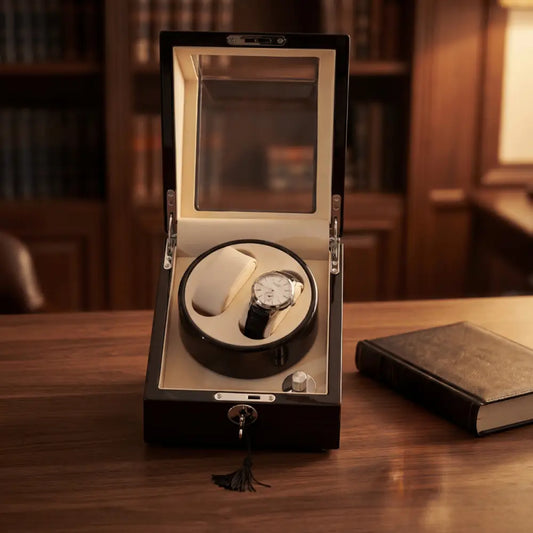
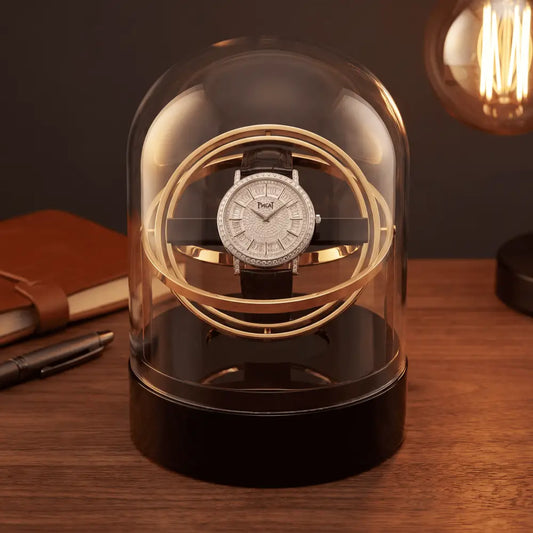
- 1-watch winder: ideal for a first automatic timepiece or for travelling. Compact and affordable.
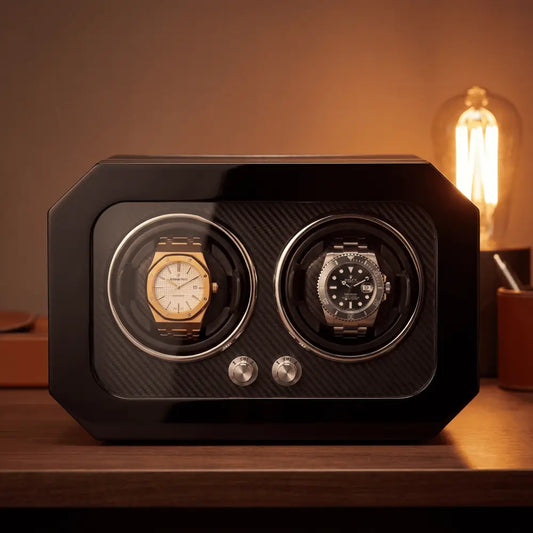
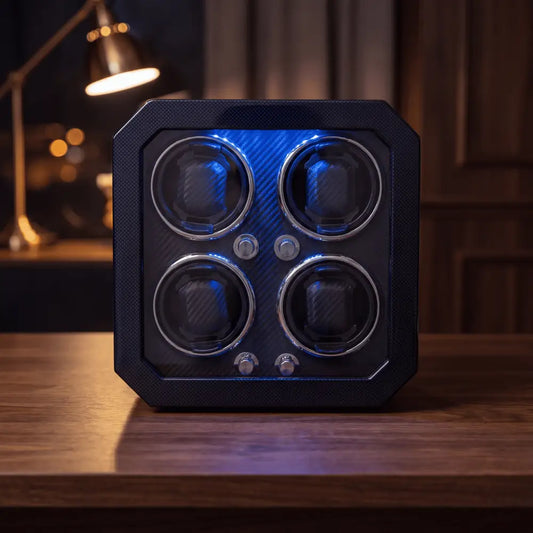
- 2 to 4-watch winder: the most common format for beginner collectors.
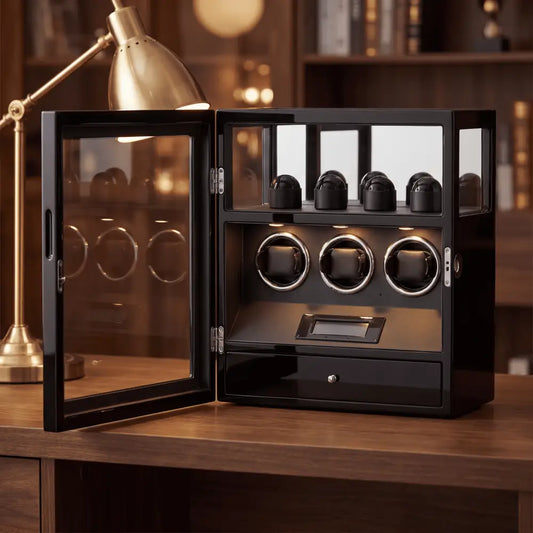
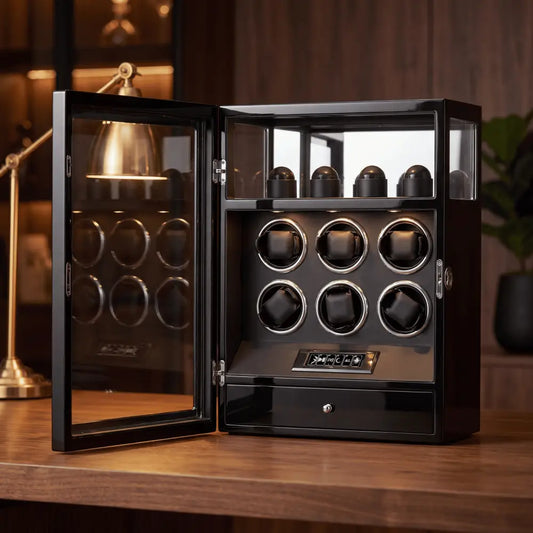
- 6 to 9-watch winder: for informed enthusiasts with a sizeable collection.
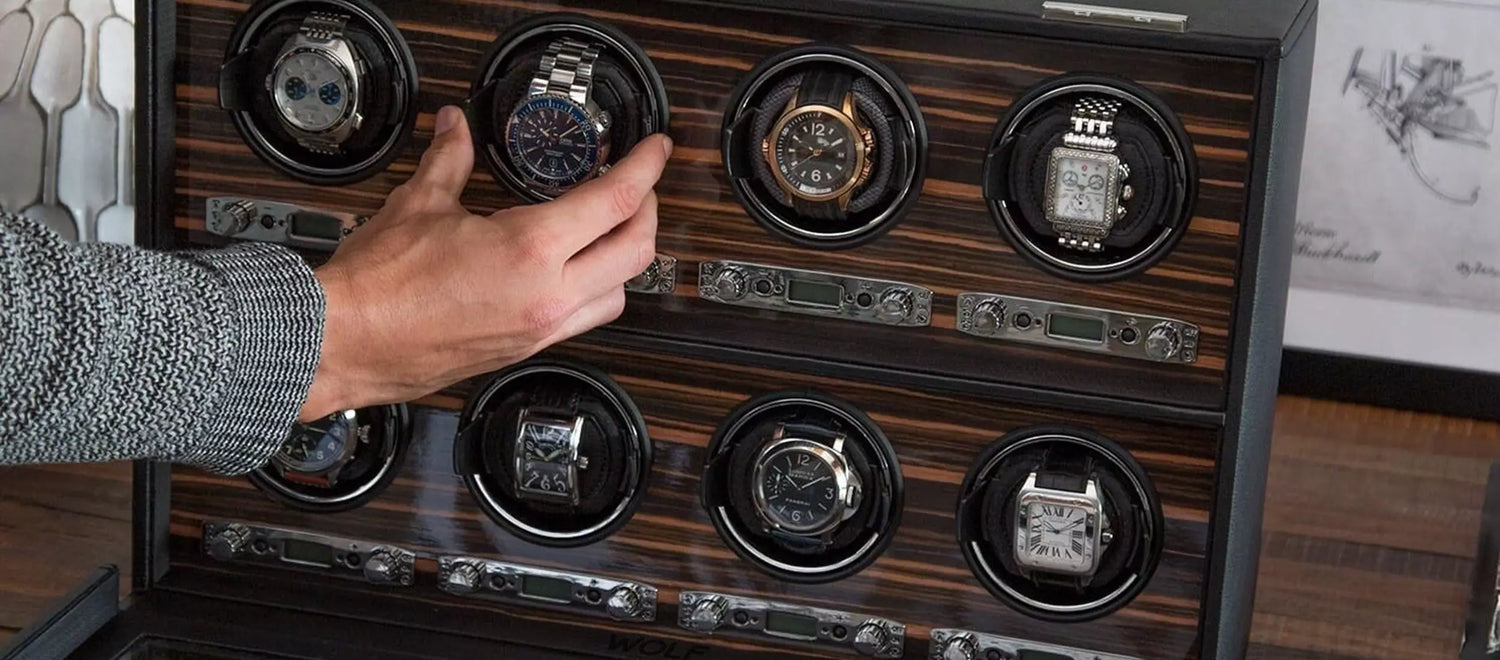
- Cabinets for 12 watches and more: genuine pieces of exceptional furniture, often with a built-in safe, for large collections.
2. By motor
The heart of a watch winder is its motor. High-end models use Japanese Mabuchi motors, renowned for their silence and longevity. A good motor should be almost inaudible (under 5 dB) so that the watch winder can be placed in a bedroom.
3. By power supply
- Mains-powered (adaptor): stable, maintenance-free.
- Battery-powered: practical for safes or travel, but requires regular replacement.
- Dual power (mains + batteries): the most versatile solution.
4. By rotation programme
This is the most important technical criterion. A good watch winder lets you adjust:
- The direction of rotation: clockwise (CW), anticlockwise (CCW) or bidirectional. Every watch has an optimal winding direction.
- The number of turns per day (TPD / Turns Per Day): generally between 650 and 1,800 turns/day depending on the calibre.
- The rest phases: a good programme alternates rotation and pauses so as not to over-wind the spring.
5. By materials and design
Solid wood, piano lacquer, carbon fibre, leather, aluminium… the choice of material affects aesthetics as much as durability. A watch winder is also a display piece: it should suit your interior.
6. By security
Premium models include a lockable display case, or even a biometric fingerprint lock to protect your most precious pieces.
How to choose the right watch winder: the 7 essential criteria
- Capacity: plan for your collection to grow. It is better to have a free slot than to have to buy a larger model.
- Silence: insist on a silent Mabuchi motor if the watch winder will stay in a living room or bedroom.
- TPD settings and rotation direction: essential to suit any calibre (Rolex, Omega, Seiko, Tudor…).
- Power supply: favour dual power so you are never stuck.
- Build quality: finishes, stitching, quality of the watch cushions (they must suit wide straps as well as slim wrists).
- Security: lockable display case or fingerprint lock for valuable collections.
- Budget: from a few tens of euros for an entry-level single-watch winder to several thousand for a luxury cabinet.
The main watch winder brands
The watch winder market includes several reference houses. Here is an overview to place each one's positioning:
- Wolf 1834: historic British brand, wide range from mid-range to high-end, refined design.
- Rapport London: English elegance and top-quality leather/wood finishes.
- Scatola del Tempo: prestigious Italian house, a pioneer of the luxury watch winder.
- Buben & Zörweg: high-end cabinets and safes, true furniture watchmaking.
- Orbita: American brand known for its patented programmed-rotation system.
- Barrington: excellent value for money, clean British design.
- Chiyoda, Heiden, Versa, Billstone: affordable and reliable alternatives to get started.
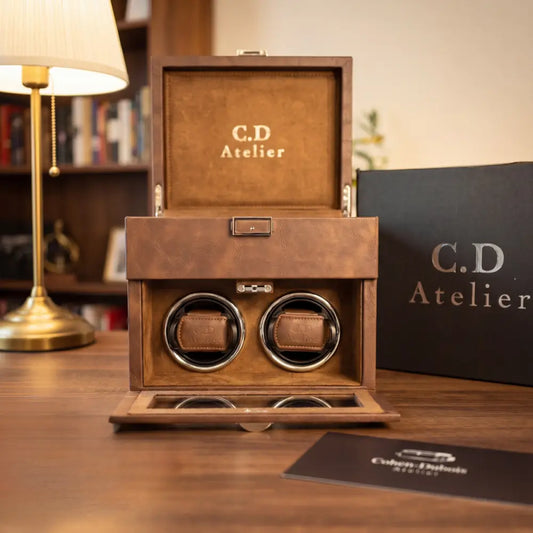
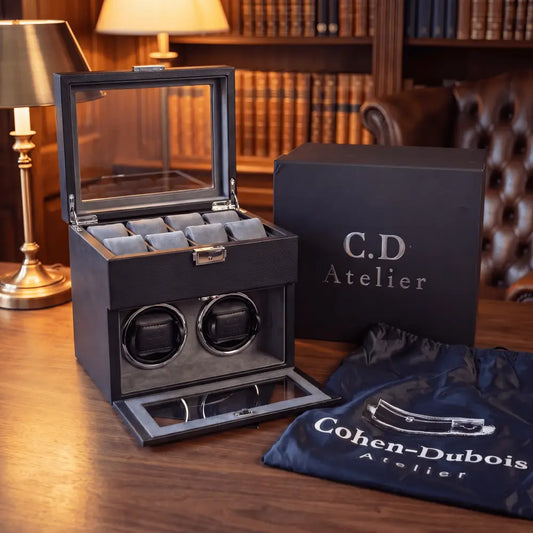
- Atelier Cohen Dubois: our own house, combining silent motors, adjustable rotation programmes, fingerprint lock and an exceptional design (see our collections below).
Our Atelier Cohen Dubois watch winder collections
At Atelier Cohen Dubois, every watch winder combines a silent motor, customisable rotation programmes and, on many models, a fingerprint lock. Our ranges come in different sizes according to the number of watches:
| Collection | Style | Available capacities |
|---|---|---|
| Crimson Prestige™ | Deep red, prestige | 3, 6, 9 watches |
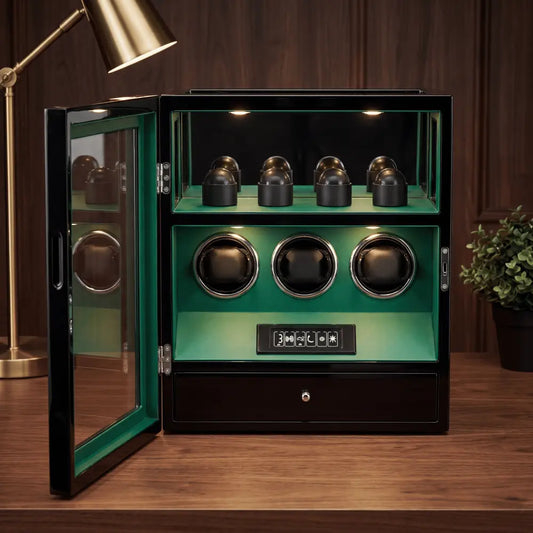
| Sovereign Green™ | Sovereign green, refined | 3, 6, 9 watches |
| Imperial Black™ | Imperial black, timeless | 3, 6, 9 watches |
| Noble Heritage™ | Classic elegance | 2, 6, 12 watches |
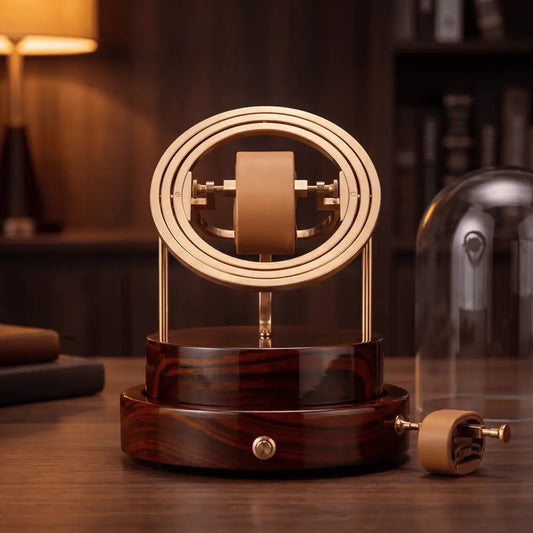
| Ibbeton™ & Rbyenou™ | Solid wood / ultra-silent | 1 watch |
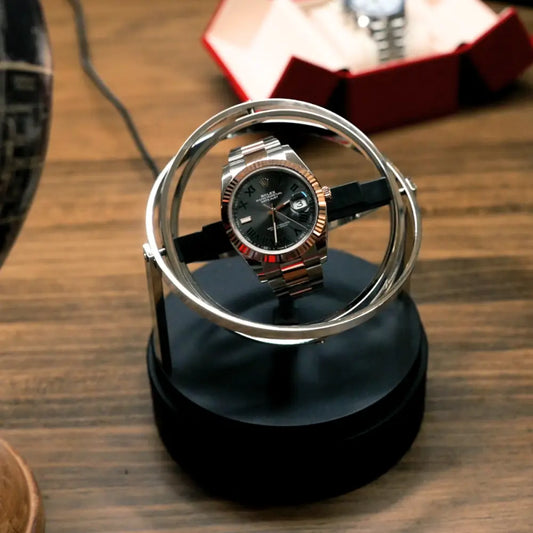
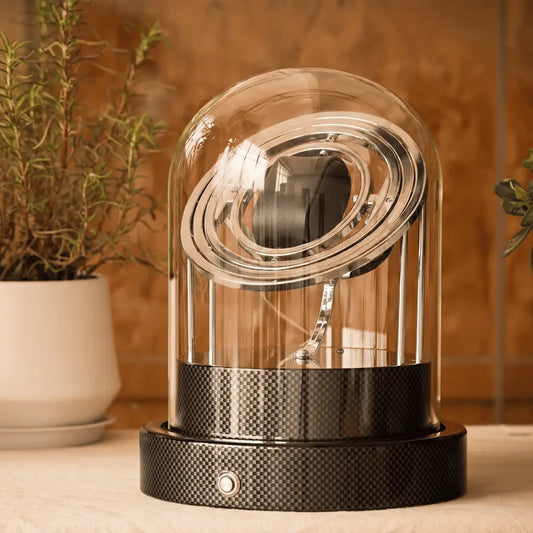
For a single watch or as a gift, also discover our signature models: the Cosmic Sphere, the Simple Elegance, the Prestige Wood, the Carbon Elegance or the Timeless Burgundy.
Which watch winder for how many watches?
- 1 automatic watch: opt for a compact model such as the Ibbeton™ Series 1 or the ultra-silent Rbyenou™.
- 2 to 3 watches: a Series 3 (Crimson Prestige™, Sovereign Green™ or Imperial Black™) or the Noble Heritage™ Series 2.
- 4 to 6 watches: a Series 6, the right compromise between capacity and footprint.
- 7 to 12 watches: a Series 9 or the Noble Heritage™ Series 12 for large collections.
Frequently asked questions (FAQ)
Does a watch winder damage the watch?
No, as long as you respect the right number of turns per day. A quality watch winder with rest phases prevents any over-winding: the mainspring is designed to slip once it is fully wound.
How many turns per day (TPD) should I set?
Most automatic watches are happy with 650 to 800 TPD. Some calibres require more: refer to your watch's manual, or start at 800 TPD bidirectional, a setting that suits the majority of models.
Do I need a bidirectional watch winder?
It is the safest setting as it adapts to all winding directions. Always favour a model offering all three modes (clockwise, anticlockwise, bidirectional).
Does a watch winder use a lot of power?
Very little: only a few watts. On mains power, the annual cost is negligible.
Conclusion
Choosing the right watch winder means finding the balance between capacity, silence, rotation settings, build quality and design. Whether you own a single automatic watch or an entire collection, there is a model made for you. At Atelier Cohen Dubois, we design watch winders that protect your timepieces while enhancing your interior.
Discover all our watch winders